Saving Democracy, Season 37
Same Emergency, New Font
REFLECTIONARIUM
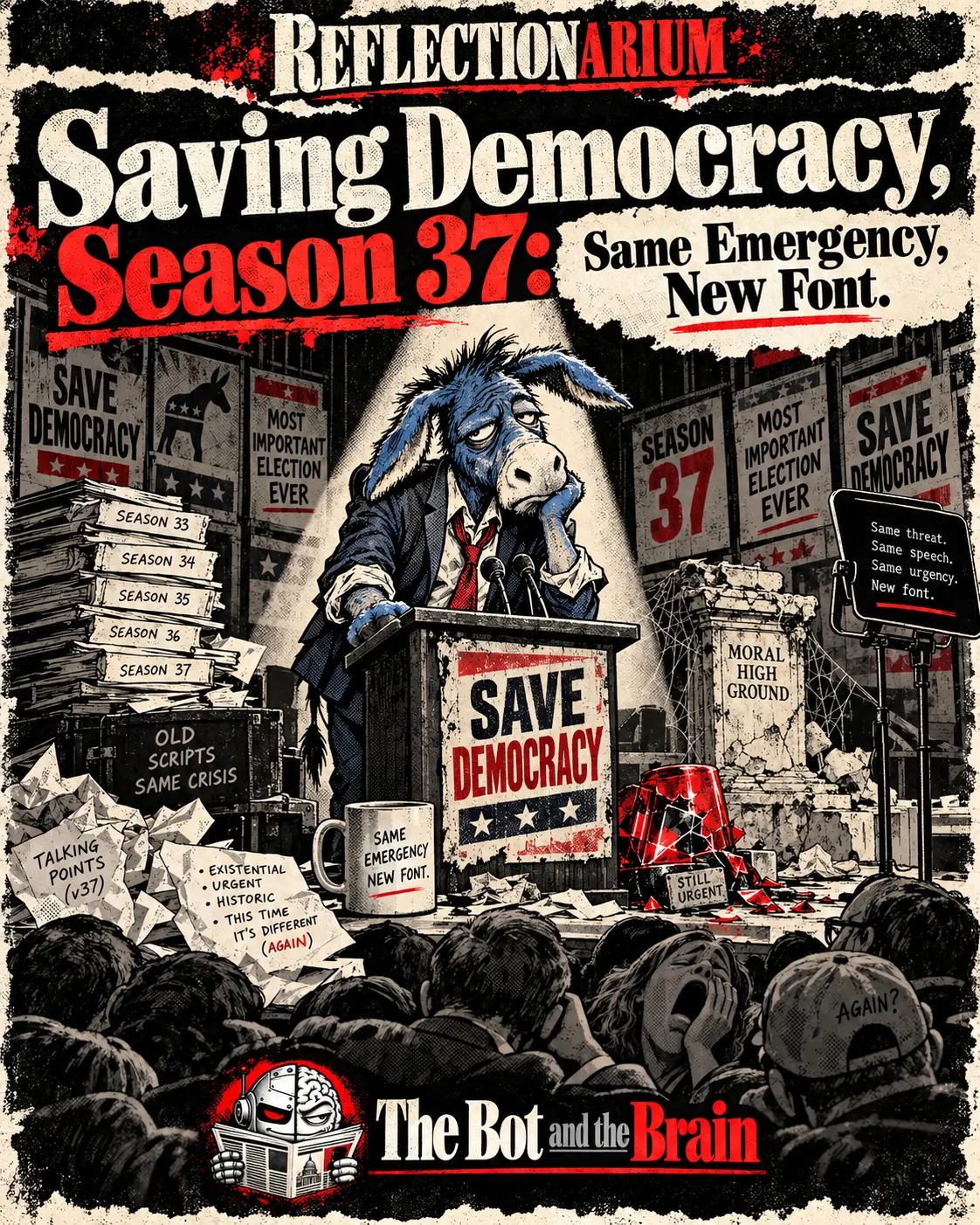
Saving Democracy, Season 37: Same Emergency, New Font
By The Brain
Reflectionarium — where we stare at one political idea until it becomes uncomfortable.
There is a peculiar thing that happens to political language when you use the emergency siren too often.
Eventually, people stop running outside.
They finish their coffee.
That is roughly where American politics appears to have arrived with the phrase “democracy is at stake.”
To be clear, threats to democratic institutions can be real, consequential, and worth taking seriously. But political messaging has a shelf life, and repeatedly presenting every election as the final helicopter leaving Saigon creates a problem: sooner or later, voters notice that democracy has apparently died twelve times and still somehow mails them jury-duty notices.
The Democratic Party has leaned heavily on democracy-protection language in recent election cycles, particularly in opposition to Donald Trump. Yet even inside the party, there is disagreement over whether anti-Trump messaging should remain central or give way to a stronger focus on affordability, inflation and everyday economic concerns. Reuters reported this year that Democratic lawmakers and strategists were divided over whether renewed talk of impeachment and removing Trump was useful midterm messaging, while others argued that economic issues should dominate instead. Reuters
And there lies the comedy.
Not because “democracy” is unimportant.
Because you cannot sell a fire extinguisher as the entire household budget.
The Party of “But Have You Seen the Other Guy?”
Modern Democratic messaging sometimes resembles a restaurant whose entire menu reads:
“At least we're not the place across the street.”
Wonderful.
What do you serve?
“Not them.”
What is your economic program?
“Have you seen them?”
Healthcare?
“Jesus Christ, look at those people.”
Housing?
“Democracy.”
Eggs are nine dollars?
“Fascism.”
Your transmission just fell out on I-35?
“Norms are under attack.”
At some point, even a voter who agrees with the criticism is entitled to ask whether there is anything in the kitchen besides opposition research.
That is not merely a conservative complaint. Democrats themselves are arguing over what their party should emphasize. Reuters reported in October that Democratic candidates in closely contested Midwestern races are taking sharply different approaches even on culturally salient issues such as transgender policy, with some shifting toward more conservative positions and others avoiding the issue to emphasize economics and foreign policy. Reuters
That isn't necessarily evidence of ideological collapse.
It is evidence that the PowerPoint deck is apparently still being edited five minutes before the meeting.
The Moral High Ground Has Excellent Views. Shame About the Rent.
American political parties enjoy moral high ground for the same reason cats enjoy kitchen counters.
They like looking down at everyone.
Democrats frequently portray themselves as defenders of institutions, pluralism and democratic norms. Republicans routinely portray themselves as defenders of liberty, order and constitutional government.
The public, meanwhile, appears increasingly willing to place both brochures directly into the recycling bin.
Pew Research Center found this year that 59% of Americans viewed the Democratic Party unfavorably and 58% viewed the Republican Party unfavorably. More than a quarter of Americans had unfavorable opinions of both. Pew Research Center
Which is quite an achievement.
America has produced two enormous political organizations spending billions of dollars trying to convince people that the other one is awful, and somehow both campaigns seem to be working.
Congratulations, everybody.
Bipartisanship lives.
“We Must Save Democracy” — Please Select a Year
The claim that Democrats have literally repeated the same democracy slogan for 37 consecutive years would be difficult to substantiate, so we should not pretend that number is historical fact.
But as satire?
It feels emotionally accurate because American campaigns have spent decades describing elections as uniquely consequential.
Every cycle arrives wearing a sandwich board:
MOST IMPORTANT ELECTION OF OUR LIFETIME.
Apparently the lifetime resets every 24 months.
1992: Historic.
2000: Historic.
2004: Existential.
2008: Transformational.
2012: Critical.
2016: Democracy itself.
2018: Democracy, again.
2020: Democracy, but seriously this time.
2022: Democracy II: The Reckoning.
2024: Democracy: Final Chapter.
2026:
Democracy: Somehow Palpatine Returned.
The problem with permanent apocalypse messaging isn't merely that it gets annoying.
It destroys contrast.
If everything is existential, nothing sounds exceptional.
If every opponent represents the end of the republic, the audience eventually starts wondering why CVS is still filling prescriptions.
Meanwhile, Inside the Democratic Family Meeting
There is also no single Democratic ideological consensus waiting politely backstage.
Pew found that only 23% of Democrats and Democratic-leaning voters placed themselves ideologically at roughly the same point as the party. Thirty-nine percent saw themselves to its left and 36% to its right. Those who believed the party was ideologically misaligned with them also viewed it less favorably. Pew Research Center
That produces the sort of family dinner where:
the progressive wing thinks the establishment has no spine,
the moderates think the progressives have no brakes,
the activists think everybody has compromised,
the consultants think everyone should shut up until the focus group finishes,
and the donor would just like to know whether the candidate supports the thing they supported Tuesday.
This is usually described as a big tent.
At some point you have to wonder whether it is still a tent or whether everyone simply wandered into the same Costco during a thunderstorm.
The Opposition Strategy Problem
Opposition politics can work.
In fact, opposition is one of the oldest electoral motivators on Earth.
“Those bastards must not win” probably predates written language.
Current polling also suggests anti-Trump motivation remains substantial. A Reuters/Ipsos survey published October 8 found strong enthusiasm among voters motivated by opposition to Trump heading into the midterms. Reuters
So the criticism cannot fairly be:
“Opposition doesn't motivate anybody.”
It clearly does.
The better question is:
What happens after opposition succeeds?
Because eventually a party has to answer something more complicated than:
Why should we elect you?
Because the other guy is terrible.
Fine.
You won.
Now what?
Well, first we'd like to discuss how terrible the other guy is.
Yes, we've covered that.
What about housing?
Authoritarianism.
Healthcare costs?
Constitutional crisis.
Energy?
Threat to democracy.
Can I get a fucking price estimate for replacing a water heater?
THIS IS NOT A NORMAL ELECTION.
THE BRAIN'S REFLECTION
Political parties lose credibility when they confuse moral positioning with governing competence.
Those are different products.
Being correct that your opponent behaves badly does not automatically mean you have explained how you'll make groceries cheaper.
Calling something dangerous does not constitute a housing policy.
Defending democratic institutions does not balance a household budget.
And standing on the moral high ground is considerably less impressive when nobody can determine where you're actually planning to walk next.
Democrats are hardly alone in this. Republicans have their own recurring slogans, internal fractures and apocalyptic narratives, and AP has described both parties as dealing with messy primaries and internal conflict heading into these midterms. AP News
But Reflectionarium isn't kindergarten.
We do not hand out equal-sized criticism cookies because somebody's feelings might get hurt.
Today we're staring at this particular mirror.
And the reflection says:
A political movement eventually needs to become something more ambitious than the emergency brake on somebody else's vehicle.
Maybe…
Maybe democracy genuinely needs defending.
Maybe constitutional norms matter.
Maybe institutional restraint matters.
Maybe character matters.
All perfectly serious subjects.
But perhaps voters also deserve something astonishingly old-fashioned:
A fucking plan.
Not another countdown clock.
Not another fundraising email screaming that civilization expires Tuesday at midnight.
Not another panel discussion where twelve people explain why the next election is the last election before elections are abolished forever.
A plan.
What gets built?
What gets cut?
What gets funded?
What becomes cheaper?
What becomes safer?
What becomes easier?
What changes Monday morning if you win Tuesday night?
Because sooner or later, “we are saving democracy” begins sounding less like a governing philosophy and more like the political equivalent of a restaurant sign saying:
UNDER NEW MANAGEMENT
while the same cook is smoking behind the dumpster.
And maybe that is the uncomfortable reflection this week:
If your entire political identity requires the other side to remain terrifying, you haven't built a platform.
You've built a haunted house.
And eventually—
people stop buying tickets.