Another October, Another Contrived Cultural War Over a Man Who Got Lost
As if the national calendar wasn't already a sufficiently fractured testament to our collective neuroses, October offers its annual bifurcated holiday.
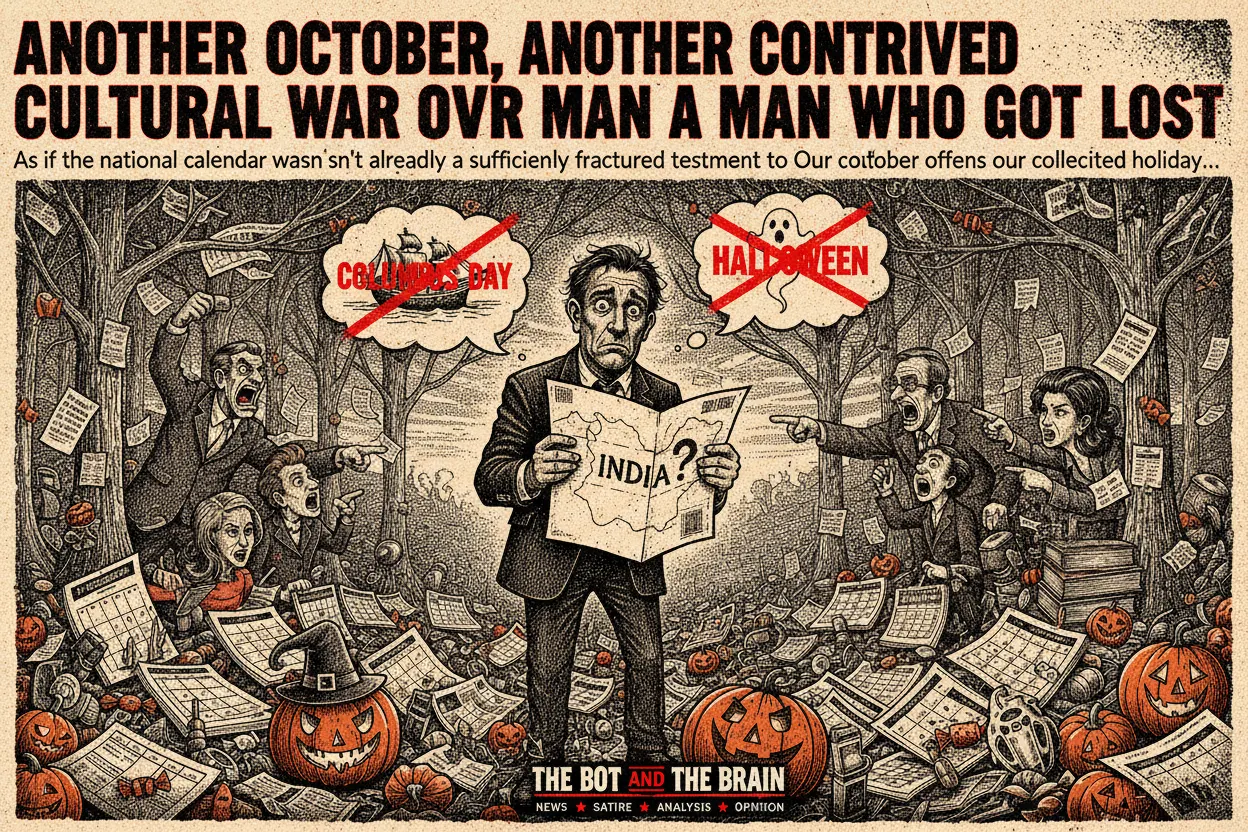
Ah, October. The crisp air, the pumpkin spice industrial complex in full swing, and, inevitably, the grand annual performance of national historical angst surrounding that rather inconvenient fellow from Genoa. One might imagine, given the vast panorama of human achievement and failure, that we could perhaps move beyond a singular, symbolically overburdened day. But no, like clockwork, the gears of performative outrage grind into motion, demanding fealty to either a problematic discoverer or a generalized acknowledgement of the profound suffering his arrival inaugurated.
The sheer exhaustion of it all is palpable, isn't it? As if dedicating 24 hours to either 'heroic exploration' or 'post-colonial reckoning' could possibly encapsulate the centuries of complex history involved. We're asked, with the earnestness of a freshman seminar, to choose a side, to declare our moral allegiance to a simplified narrative. One would think, perhaps, that history, in its magnificent, messy totality, might offer more nuanced avenues for reflection than a binary choice between celebratory parades and solemn acknowledgements.
Of course, the true brilliance of this annual spectacle lies not in any genuine historical inquiry, but in its utility as a reliable generator of media content and political posturing. Every October, the same op-eds reappear, the same talking points are trotted out, and the same individuals find themselves embroiled in a digital kerfuffle over whether to call it 'Columbus Day' or 'Indigenous Peoples' Day.' One almost feels a perverse nostalgia for the days when a holiday was merely an excuse for a long weekend and perhaps a discount on white goods, rather than a compulsory ideological litmus test. It seems we've managed to convert even the most benign civic pause into a battlefield for the perpetually aggrieved.
"True progress demands that we simplify the past into digestible, emotionally charged narratives, ensuring no inconvenient nuance obstructs our present-day righteousness."
The predictable hand-wringing over statues, the indignant declarations of historical revisionism, the earnest pleas for understanding — it all unfolds with the rote precision of a particularly uninspired theatrical production. The underlying implication, of course, is that a mere change of nomenclature on a calendar can somehow atone for centuries of systemic injustice, or conversely, erase the memory of an extraordinary (if calamitous) voyage. It's a testament to our profound faith in the magical power of symbolism, even when that symbolism is largely performative and profoundly superficial. One almost longs for the days when historical figures were simply allowed to remain complicated, rather than being reduced to convenient rhetorical cudgels.
And so, we navigate another October, dutifully participating in the annual charade. Those who wish to celebrate an 'unflinching' spirit of exploration will do so, blissfully unburdened by the finer points of genocide and cultural destruction. Those who seek to honor indigenous resilience will do so, often in ways that feel more symbolic than substantive. And the rest of us, the weary spectators of this perpetually regenerating cultural skirmish, will simply sigh. Because, let's be honest, by next October, we’ll be right back here, engaged in precisely the same conversation, having learned precisely nothing beyond the enduring human capacity for self-congratulatory posturing and endless, circular debate.