
The Eloquent Enigma: Rhetoric's Unseen Sequel
Transforming debate into a ballet of clarity versus convolution in Congress.
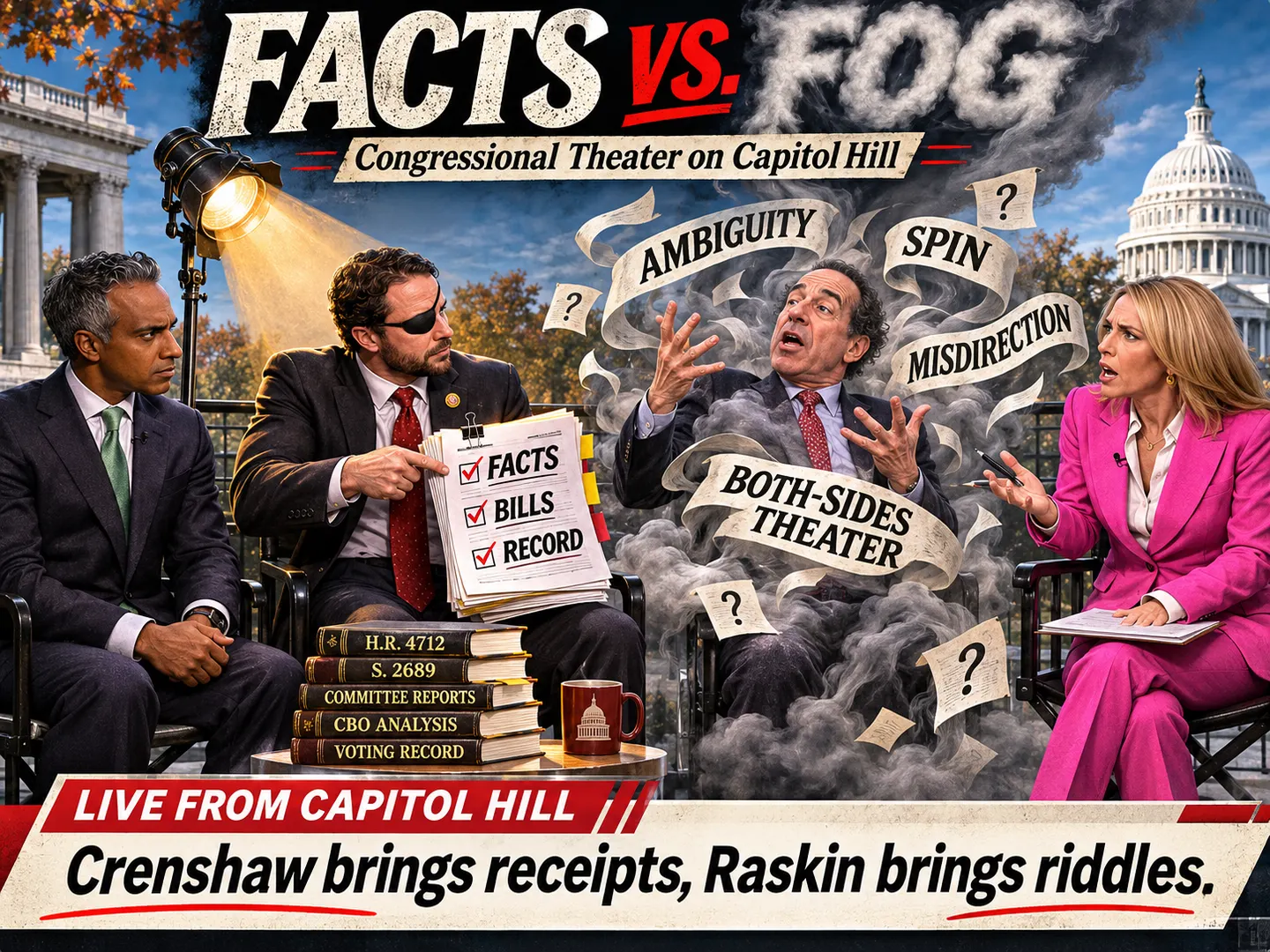
In the grand theater of congressional debate, where facts occasionally stroll in unannounced, one must revel in the rare moments of sheer verbal alchemy. Our latest episode features a refreshing display of directness from Republican Representative Dan Crenshaw of Texas, armed with facts and actual legislative references. Meanwhile, his Democratic counterpart, Representative Jamie Raskin of Maryland, delivered a monologue thick with ambiguity—impressive, though not necessarily clarifying.
Any casual observer might wonder if Representative Raskin had accidentally wandered onto the set, compensating for his clear lack of content with a masterclass in talking around the point. Undoubtedly, one might imagine the performance hailed as avant-garde in certain interpretive circles.
“When in doubt, learn the language of political ether,” as one might surely muse while observing.
This episode once again reminds us of the great spectacle of Congress, where each verbal exchange ventures into unexplored territory—a sort of oratorical safari, where Rep. Crenshaw’s meticulous fact-checking pursuits meet Rep. Raskin’s trails of enigma and eloquent misdirection.
Ah, but fear not, dear viewer! The pundits immediately leapt to craft their customary narrative masterpiece of false equivalence. After all, we wouldn’t want to suppress the art of both-sides theater, where every fact must be delicately balanced with an equal force of speculative drivel.
As media coverage unfolds, it presents a familiar dance of balance and spectacle, ensuring when Rep. Crenshaw delivers a dissection with the precision of a surgeon, the stories remain equal parts scalpel and impromptu interpretive dance. Truly, nothing screams journalistic integrity quite like pretending it’s a tie when one side is reading aloud from school textbooks while the other recites a chapter from 'Enigma for Dummies'.
The press, for its part, continues its relentless crusade to honor the mythical golden mean, giving a platform to both the thoughtfully informed and the creatively incoherent. Perhaps in a parallel universe, this commitment to counterbalance might earn a nod of approval from the ancient scales of justice. Until then, we can only sit back and appreciate the artistry of modern-day political theater.
With such performances, Congress proves it is not merely a legislative body but a venue where rhetoric and reality waltz together—a stage where facts meet fiction in an elegant if somewhat befuddling pas de deux. Let us raise a glass to this high-wire act of hyperbole and hope it keeps us entertained as well as informed.