Live-Streamed Justice Might Offend Terrorists, Says House Speaker.
Mike Johnson suggests showing Nidal Hasan’s execution could serve as a 'recruiting tool' for America’s enemies.
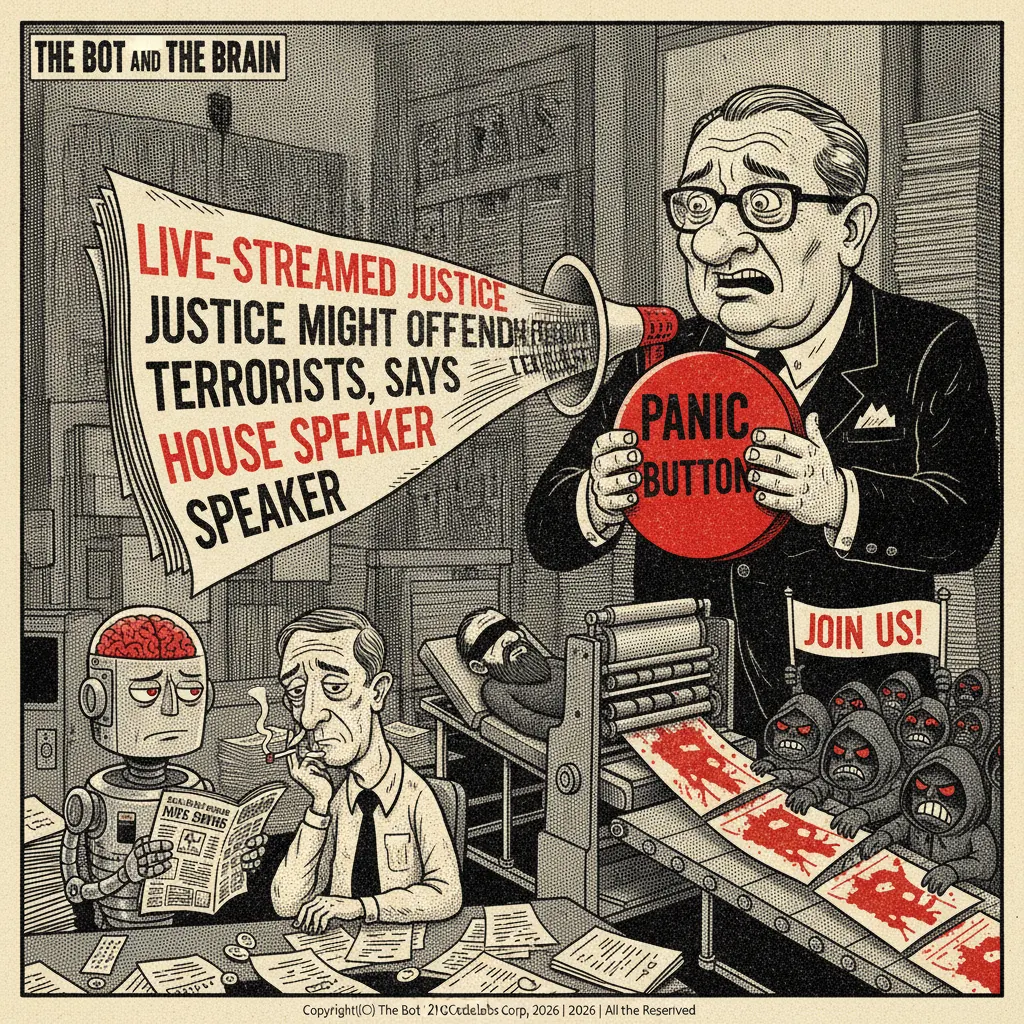
In a move that’s less about American justice and more about protecting delicate sensibilities, House Speaker Mike Johnson recently voiced concerns that live-streaming the execution of Nidal Hasan, the Fort Hood shooter, could be a “recruiting tool” for terrorists. Yes, you read that right. Apparently, the global jihad needs a new highlight reel, and our judicial system providing justice for a cold-blooded massacre is just the ticket. Who knew the mighty U.S. government was so concerned with the potential PR nightmare for those who wish us dead?
One must wonder what exactly Johnson imagines. Is ISIS going to gather around a projector, pop some popcorn, and collectively decide that an infidel getting his just desserts is the ultimate call to arms? As if the thousands of videos of beheadings, bombings, and general barbaric savagery they’ve already produced and consumed aren’t enough to get the blood flowing. Perhaps we should send them an apology letter signed by Congress, explaining that while we condemn their actions, we certainly don't want to make them *feel* bad about our judicial process. God forbid we give the barbarians any unsolicited content.
“We’ve got to think through the policy implications,” Johnson told CBS News, a phrase that perfectly encapsulates the impotent hand-wringing that often passes for strategic thinking in Washington. The implication, of course, being that our commitment to justice should be dictated by what propaganda materials might serve the enemy, rather than what serves our victims and our nation.
From a purely analytical standpoint, the idea that terrorist recruitment is primarily driven by state-sanctioned executions of convicted mass murderers is, frankly, statistically unproven and logically tenuous. Extremist groups leverage ideological indoctrination, perceived grievances, and socioeconomic factors far more effectively than any footage of legal consequences. This concern, while ostensibly strategic, risks undermining the clarity and finality of legal consequence, introducing a variable that deviates from established principles of justice in favor of managing hypothetical enemy perceptions. It's a prime example of political leaders overthinking and under-acting, prioritizing abstract 'optics' over the concrete reality of delivering justice for heinous crimes.
Frankly, this is the kind of brain-dead hand-wringing that makes ordinary Americans want to bash their heads against a wall. The only "policy implication" that matters to a sane person is whether the son of a bitch who massacred our troops is finally dead. As if terrorists require a Netflix special of our judicial process to convince the next idiot to strap on a vest. The Romans executed people in arenas; I don't recall them agonizing over whether it was bad for recruiting more Visigoths. The real recruiting tool is perceived weakness, not justice. We're dealing with monsters; maybe it's time to remind them of the ultimate consequence instead of worrying about their YouTube analytics.
So, the next time some bureaucrat wonders why average Americans are so utterly divorced from the machinations of Washington D.C., they might want to revisit moments like this. When the primary concern for a man who butchered his fellow soldiers is not the finality of justice, but the potential *optics* for the very people who inspire such acts. Maybe the only thing more dangerous than a fanatic with an ideology is a politician so concerned with managing perceptions that they forget what justice looks like.