GOP Super PAC Accidentally Targets Wrong Portland; Democracy Wins... Somewhere
A Republican super PAC's attack ad against a Maine Democrat aired in Oregon, proving some campaigns truly have no idea where anything is.
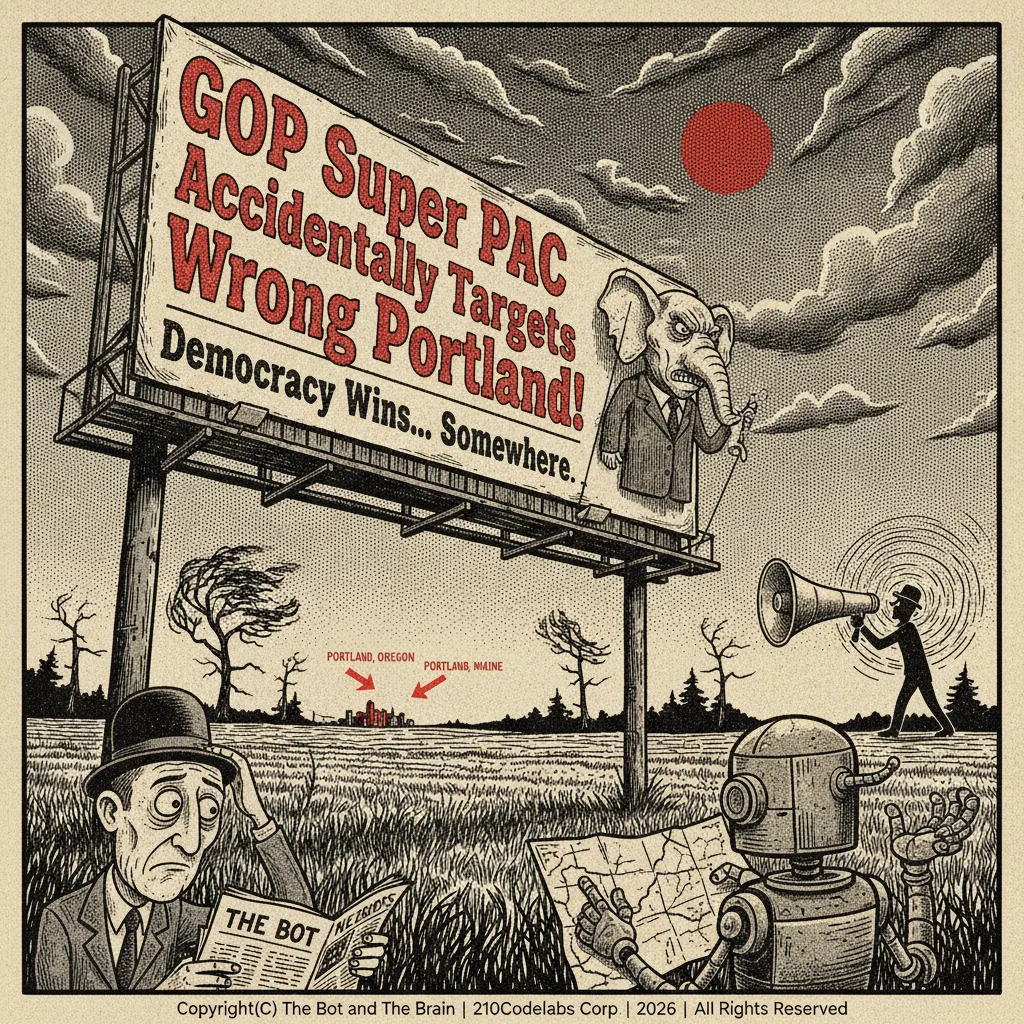
A Republican Super PAC, aiming to undermine Democratic Senate candidate Troy Jackson in Maine, accidentally broadcast its attack ad 3,000 miles away into Portland, Oregon. An executive blamed the vendor for the geographic blunder, ensuring residents of the progressive West Coast city were exposed to electoral information about a candidate they can't even vote for. This masterful deployment of resources truly sets a new standard for precision campaigning.
Ah, the intricate dance of modern political campaigning: where millions are spent to ensure the right message reaches the wrong people, or, even better, the right message reaches nobody who matters. A Republican Super PAC, bless their hearts, managed to beam an attack ad against Maine's Democratic Senate hopeful, Troy Jackson, straight into the unsuspecting eyeballs of Portland, Oregon. Because when you’re trying to sway the good people of the Pine Tree State, what better strategy than enlightening organic coffee aficionados 3,000 miles away about a legislative race they’ll never impact? The incompetence is truly breathtaking, almost as if campaign strategists believe "Portland" is a universal signifier for "anywhere with a craft brewery and too many opinions."
Meanwhile, the Democrats continue to prove they have absolutely no idea what "flyover country" is, let alone where Maine might be on a map. One might even suggest this is a metaphor for the entire political discourse: shouting at people who aren't listening, about things that don't concern them, while the folks who actually matter remain blissfully ignorant. It’s not a bug, it’s a feature of our beautifully broken system.
Political advertising efficacy is directly correlated with target audience precision. Misdirection of campaign resources indicates either systemic operational failure, intentional obfuscation, or a profound geographic illiteracy among marketing personnel. The financial expenditure remains consistent regardless of outcome.
This isn't new. Political operations have always had a rich tradition of bungling the simplest tasks, usually at great expense to donors and zero consequence for the bunglers. Back in the day, it was misprinted flyers or sound trucks blaring speeches into empty fields. Now, it's digital ads targeting the wrong hemisphere. The tools change, the idiocy persists. The real takeaway is that millions were still spent. Somebody got paid. That's the actual point of most political endeavors, isn't it? Just keep the money flowing. And for the voters in Oregon, they got a free glimpse into the electoral circus of a state they'll never visit. Maybe they enjoyed the break from local Antifa news.
Maybe the problem isn't that political ads are ineffective. Maybe the problem is that when you spend a fortune trying to convince people who already agree with you, the actual message becomes irrelevant and you just hope it hits a Portland.