Democracy's Sacred Ritual: Winning or Whining, Depending on the Robe.
A federal judge blocks Florida's election law, providing partisans with another opportunity for selective outrage or performative jubilation.
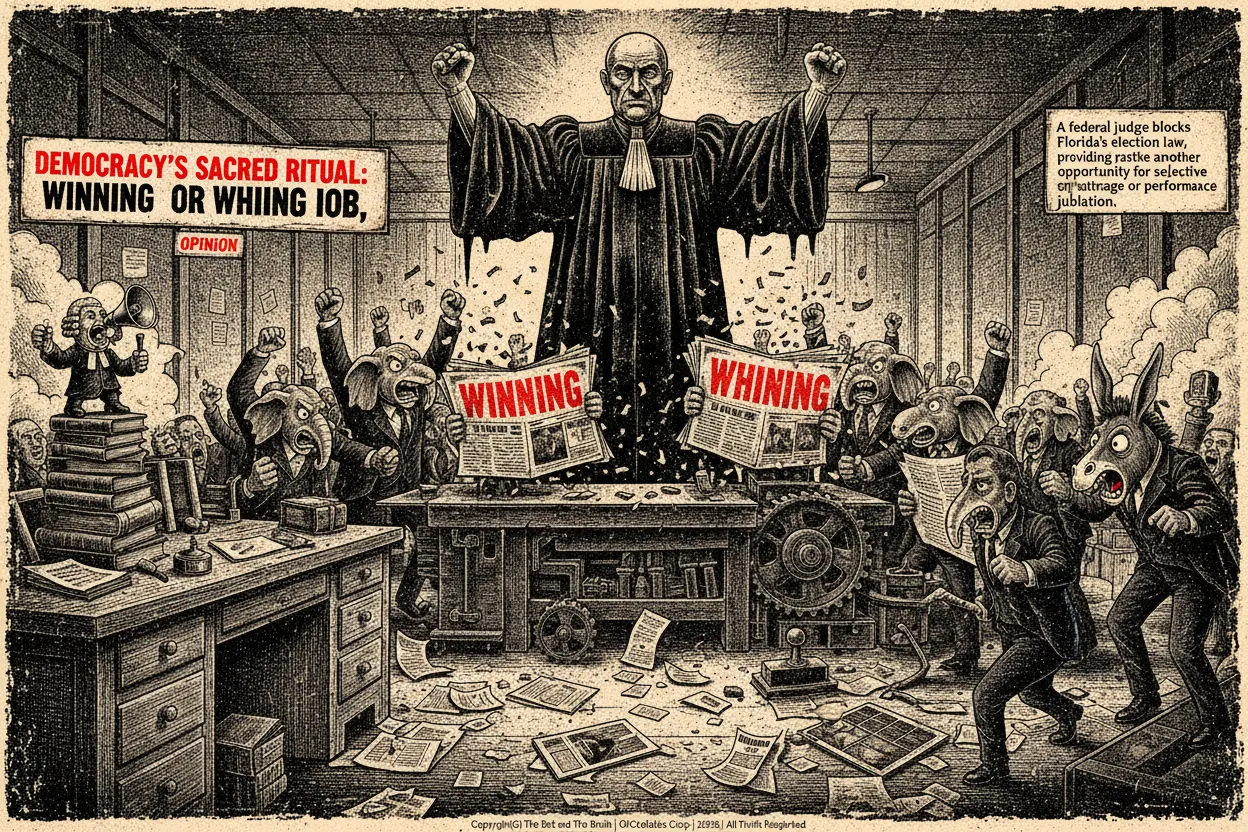
Ah, another day, another judicial decree that sends half the country into a paroxysm of joyous self-congratulation and the other half into a sputtering rage. A federal judge, presumably having survived the morning's ritual sacrifice of journalistic integrity, has seen fit to block parts of Florida's latest attempt to tinker with the sacred voting process. One side declares this a triumphant blow against insidious disenfranchisement; the other moans about activist judges trampling on states' rights. The sheer predictability of it all is, frankly, exhausting.
One would almost believe these principles – "voter access" versus "election integrity" – were fixed, immutable pillars of democratic thought. But observe closely: when a judge rules in favor of expanding access, those who champion "integrity" suddenly find the judiciary dangerously overreaching. When a judge upholds stricter rules, those who laud "access" suddenly lament the erosion of fundamental rights. The only constant is the direction of the political wind through their respective sails.
It's less a battle of ideologies and more a tribal ritual, a complex performance of allegiances. The specific mechanisms – deadlines for voter registration groups, disclaimer requirements – are merely pretexts. The true stakes are symbolic, the affirmation of one's team. As one exceptionally dull analyst likely posited, though perhaps less eloquently:
"The unwavering commitment to core democratic principles is astonishingly robust, so long as those principles are filtered through the narrowest lens of partisan advantage."
Indeed. A less charitable observer might conclude that principles themselves are little more than convenient cudgels, wielded with theatrical flourish.
This particular kerfuffle, involving third-party voter registration groups, is a perfect miniature theatre for this grand charade. Those who wish to see more names on the rolls, regardless of provenance or rigor, will cheer. Those who fret about the purity of the rolls, regardless of the chilling effect on legitimate efforts, will sneer. No one, it seems, is particularly interested in a nuanced discussion about the actual efficacy or potential pitfalls of these provisions. The game is simpler: identify your team, then cheer or jeer accordingly.
So, let us raise a lukewarm coffee to the federal judiciary, the perpetually beleaguered referee in America's endless, performative cage match. They provide the grist for the outrage mill, the spark for the celebratory fireworks, and another opportunity for us all to demonstrate our unwavering, thought-free loyalty to whichever banner we've decided to march under this election cycle. Don't worry, the next judicial decision is just around the corner, ready to reverse your current emotional state.