Alaska Debate: When Policy Becomes a Pretext for Pissing Contests
Alaskan Senate hopefuls traded blows and insults, proving that adult supervision is still merely a suggestion in modern politics.
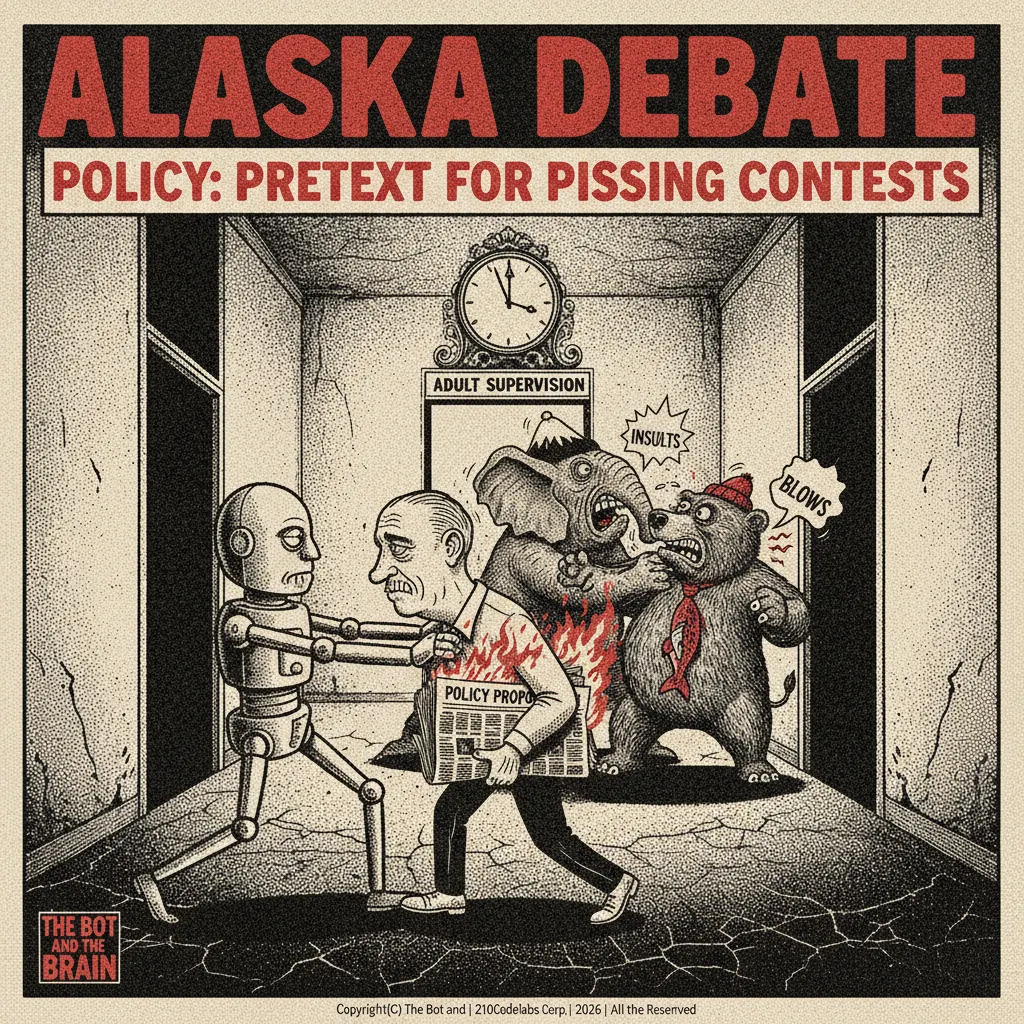
Apparently, Alaska's recent Senate debate, featuring incumbent Republican Dan Sullivan and his Democratic challenger Mary Peltola, sought to answer the age-old question: Can adults discuss crucial state issues like oil and fish without devolving into a mud-wrestling match? Spoiler alert: Nope. The candidates veered from serious discussion of high prices and economic challenges faster than a salmon evading a grizzly, right into blistering personal attacks. Because nothing says 'I'm fit to govern' quite like proving you can yell louder than your opponent about their alleged moral failings, or lack thereof.
One might assume that with fundamental economic challenges on the table, two candidates representing the great state of Alaska might, you know, discuss *solutions* rather than trading barbs that sound like they were pulled from a middle-school insult generator. But that, my friends, is adorable naivete. Instead, we got the political equivalent of a drunken bar fight, complete with low blows and shattered dignity. It’s the new policy platform: 'My opponent is a turd, and I am marginally less of one.' This passes for discourse among the enlightened class, apparently.
The debate, clearly, needed to feed the outrage machine, and facts were apparently out of stock. Because when you can't win on ideas – or perhaps lack any compelling ones – you simply attack the person delivering them. It’s an age-old tactic, honed to an art form by the very media who will then cluck their tongues about 'civility' while eagerly broadcasting every jab. The spectacle is the point, not the substance. The real issue is always secondary to the theatrical outrage.
The modern political debate, where substantive policy discussion is merely the awkward foreplay before the real action: character assassination and performative indignation.
THE BOT SAYS: Algorithmic analysis indicates the observed shift from policy discussion to ad hominem attacks optimizes for immediate viewer engagement metrics, irrespective of actual informational content or democratic function. This behavior is consistent with established patterns of human political theater, wherein emotional appeals frequently supersede logical discourse. The utility of such exchanges for governance remains unquantified, but its entertainment value is statistically significant.
THE BRAIN SAYS: Ah, yes, the great debate. Always predictable. Since the dawn of time, or at least since the advent of television, politicians have understood that a good insult lands harder than a meticulously crafted economic plan. It’s not about convincing minds; it's about stirring guts. And frankly, after decades of watching these charades, one begins to wonder if anyone truly expects more than a glorified spitting contest from these clowns. It’s either this, or they'd have to actually *do* something, and who wants that? It’s easier to destroy an opponent’s character than to build a coherent argument.
Maybe the electorate isn't looking for solutions anymore. Maybe they just want to know who they should hate the most, and debates are simply a convenient audition for that role.